The Very Best Room: to Dan Cyr/Hyatt Montréal-Downtown, and SPVM, with love
There is a particular kind of American magic that happens when a person becomes inconvenient.
Suddenly, everyone discovers procedure.
Everyone discovers jurisdiction.
Everyone discovers that something is “a civil matter,” or “an employment matter,” or “under review,” or “being dealt with.”
Nobody discovers the part where they actually have to help you.
I learned this in Montréal.
I was working for Matt Jones (Fairlife Dairy) and Megan Platts (Writer/Line Producer, Lily & Kat (2015) and Hpnotiq Sparkle (2014), IMDb).
The work itself is not really the story I want to tell here. Although I promise, there’s a story there too.
The story is what happened when the employment relationship broke down and I realized that the people I worked for were no longer simply people I needed to navigate professionally.
I was afraid of them.
And that distinction matters.
I’ve been fired before.
I’ve survived difficult employers before.
I’ve packed my things and held my head high before.
But this was different.
Because when your employer is also the person controlling your housing, your transportation, your access to money, your immediate physical surroundings, and the circumstances under which you leave, “you've been fired” is not exactly the same sentence as it is when someone hands you your coat in an office and says good luck.
This was a live-in care job that spanned five countries.
And there wasn't some neat little HR hallway between work and home.
The two things, unfortunately, are often a shared space.
And when the hallway disappears underneath you, you don't necessarily have anywhere else to stand.
So I called the police.
Not because I wanted drama.
Not because I wanted revenge.
Not because I thought a police officer was going to magically resolve an employment dispute.
I called because I was scared.
Megan had continued berating and threatening me by text while she was driving back from what I understood to be yet another one of her mysterious appointments in the States. I knew enough about the situation by then to know that I did not want to be alone with her if things escalated.
So, in the middle of the day, I called the police.
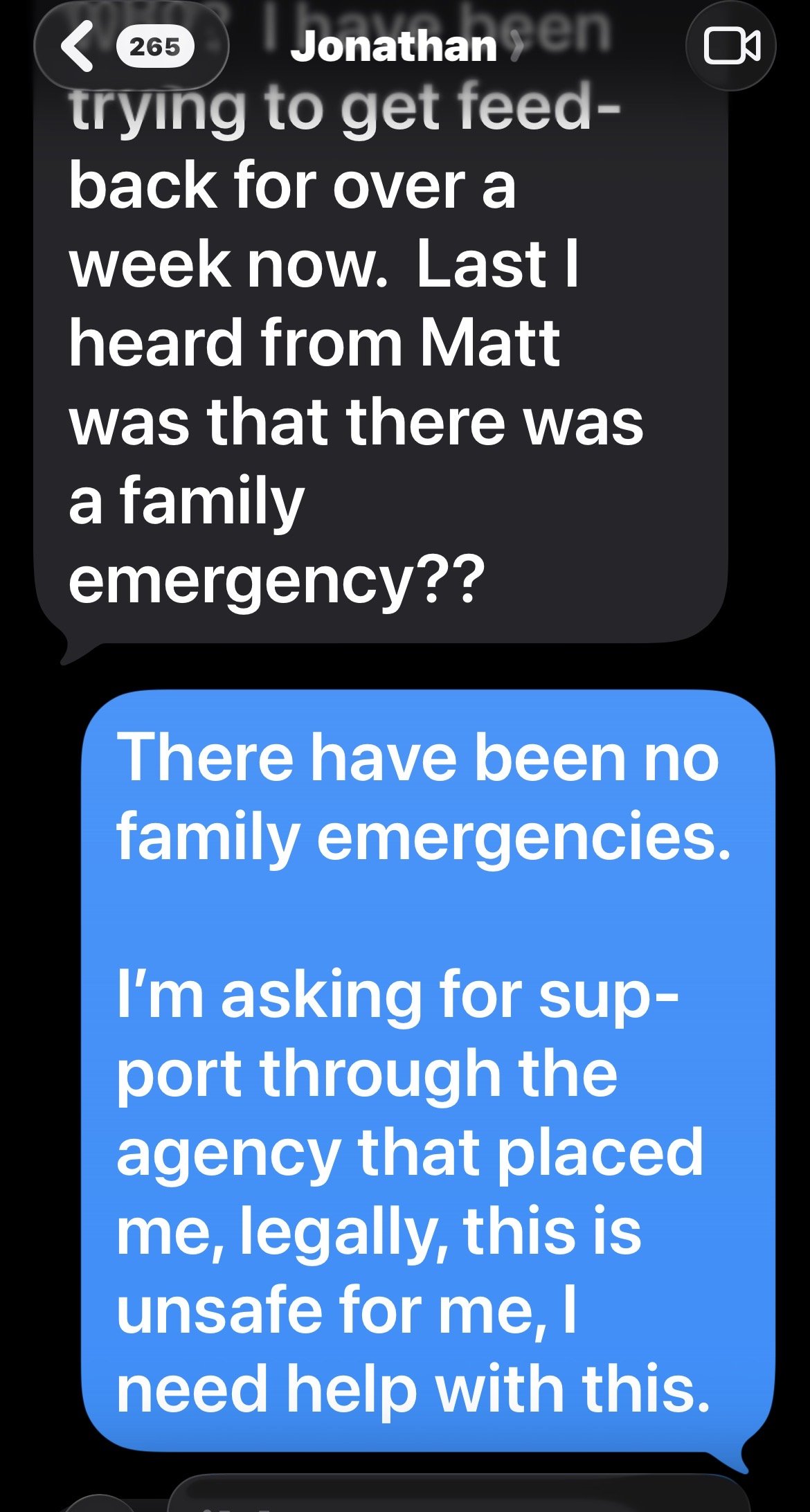
I also called the agency who placed me.
Multiple times.
I didn't know until later, but my Mom called the agency too.
We asked for help.
And, essentially, we were told by Morgan & Mallet Group’s recruiter Jonathan de Vanderbilt and CEO Morgan Richez that the agency would do nothing to assist with a safe return to the States.
And this is one of the things people don't understand about domestic work.
Everybody loves to talk about how intimate the work is.
Trust.
Family.
Connection.
You're not just a nanny.
“yOuRe pArT oF thE FaMiLY.”
Until there’s a problem.
Then, suddenly, you're an independent contractor of your own survival.
So anyway, the ‘Service de police de la Ville de Montréal’ showed up after having to follow up twice. I truly just needed someone there before Megan got back or before Matt decided to try and come into my unit again.
And what happened next is difficult to explain without sounding like I am exaggerating, which is one of the more irritating things about experiences like this.
Sometimes reality is so absurd that you have to pull the recordings, put the transcript next to it, just to make yourself feel less crazy.
SPVM allowed Megan to stand over me, berate me, insult me and come into my personal space while doing so, without intervening.
I sat as still and emotionless as I possibly could the entire time, because sudden movements from a Black woman could possibly spook the police and I didn’t have the space for those kinds of errors.
The officer escorted Megan out and spoke with she and Matt upstairs.
Then he came back into my unit.
Unannounced.
I had called the police because I was afraid of the people I was working for.
And I need people to understand what that actually means when you are a Black woman in America.
Calling the police does not erase the possibility that I will be afraid of the police, too.
I know what happens to women who look like me when they encounter law enforcement. I know that people are killed during encounters that were supposed to be about protection. I know that Black women can be killed in their sleep at the hands of law enforcement. I know that officers can make decisions in a matter of seconds, and that those decisions can have consequences that cannot be undone. I know that accountability after the fact is not guaranteed simply because somebody was wearing a badge.
So now imagine being in my position.
I am already afraid of the people who employ me.
I have called the police because I believe I may be unsafe.
And then the police officer I called comes back into my unit without announcing himself, after speaking privately with the very people I had called about.
What exactly am I supposed to do with that?
Was I supposed to feel safer?
Was I supposed to assume that whatever he says next was harmless?
Was I supposed to ignore the fact that I was alone, that these people had power over my employment and housing, that the police had just spoken with them without me, and that I had no idea what was said upstairs?
No.
I was afraid of Matt and Megan.
And now I had to be afraid of what would happen if I did not do what the police officer told me to do.
That's a very particular kind of fear.
It's the realization that the person you called for protection is also someone you have to carefully manage your behavior around because you don’t know whether he sees you as a person who needs protection, a problem to be removed, or simply another person whose compliance he expects.
I called the police for my safety.
I didn't call them to have someone take control of the situation for me.
I didn't call them to intimidate me into compliance.
I didn't call them so that the people I was afraid of could use the police as another mechanism of control.
I called because I was scared.
And somehow, standing there in my own unit, I was now calculating the possibility of being hurt by the people I had called about and the possibility of being hurt by the people I had called to help me.
That is not what safety looks like.
That's what being trapped looks like.
And then he started making it very clear that my fear was becoming an inconvenience to him.
Not just an inconvenience.
An irritation.
He told me he had “more serious” things to do.
He told me the situation was beginning to “piss him off.”
Think about that for a second.
I am standing in my own home, trying to explain why I am afraid of the people who employ me. I have already been berated. I have already had police called into the situation. I have already been fired. I am trying to figure out how I am supposed to get myself out safely.
And the response from the person who is supposed to be helping me is essentially:
I have more important things to do than this.
And that matters.
Because when you're the person asking for help, you're already vulnerable. You're already trying to figure out how much you can say, how much someone will believe you, whether telling the truth will make things worse, whether the person standing in front of you has decided that you're the problem.
So I did what people do when they realize the person with authority over the situation is no longer interested in understanding them.
I made myself smaller.
I kept saying:
“I hear you.”
“Okay.”
“Mm-hmm.”
And I wasn't agreeing with him.
I was trying to get through the interaction.
There’s a difference.
And when he told me that the situation was beginning to piss him off, after telling me he had more serious things to do, I understood exactly what he was communicating:
Stop making this my problem.
So I stopped.
Not because I suddenly believed everything was okay.
Not because I suddenly felt safe.
Because I needed the interaction to end.
And that's what you can hear in the recording and see in the transcripts.
You will hear me repeatedly tell him that I hear him.
You will hear me trying to explain that I just want to go home.
You will hear him telling me that I should take the offer and go where they told me to go.
You will hear him tell me that he doesn't want to “have to come back here.”
You will hear him tell me he has more serious things to do.
And you will hear him say that the situation is starting to piss him off.
Then you will hear the door slam.
That's the interaction.
So no, this isn't me remembering a stressful night and assigning meaning to someone's tone months later.
This is what was said.
And I've been sitting with one particular question:
As someone whose literal job it is to “protect and serve,” what the fuck are you there for if you don't have time for the person who called you because she was afraid?
I wasn't asking him to solve my employment dispute.
I wasn't asking him to determine whether I had been treated fairly.
I wasn't asking him to become my lawyer.
I was asking for help getting through a situation in which I was scared enough to call the police.
And somehow, by the end of that interaction, I was more concerned with making sure he wasn't angry than I was with whether anyone was actually protecting me.
And that's not a small detail, it's the entire point.
Because the people who have the authority to help you should not have to be convinced that your safety is worth their time.
And when they make you feel like it isn't, you learn something very quickly:
Sometimes the person you called for protection is just another person you have to survive.
So the conversation became, essentially, about leaving.
There was money being discussed.
There was a hotel.
There was the suggestion of taking the offer of being paid $500, getting in the car, and going where they sent me.
There was the question of whether I would leave immediately.
And there was the very clear message that if I did not leave, this could become a problem.
At one point, the officer told me that if Megan did not pay me, that was a civil matter.
Fine.
I understood that.
I wasn't asking the police officer to adjudicate my employment contract.
I was asking for help because I was frightened.
But somewhere along the way, the purpose of the conversation became:
She is offering you money a hotel. Take it and leave.
And I remember saying, essentially:
So you're just asking me to swallow all this shit she and her husband have put me through?
Because that was what it felt like.
Swallow it.
Pack your things.
Go.
Be grateful for the hotel.
Problem solved.
Except it wasn't solved.
I had lost my job.
I was losing my home.
They didn't pay me.
It was December.
I was in Montréal.
And I did not want to be put into a car and taken wherever I was being told to go.
But I did.
Because sometimes “choice” is a very generous word for what happens when every available option is terrible.
So I was made to get in a car and transported to a hotel.
The hotel was the Hyatt Place Montréal-Downtown.
The reservation had been arranged by Matt and/or Megan.
I was taken there.
I checked in.
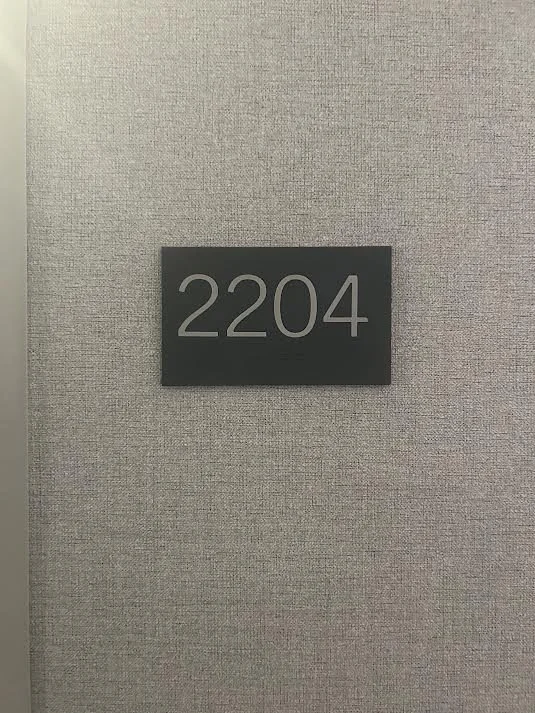
The person at the desk, Francois, looked over whatever notes were on the screen and told me I was being placed in the “very best room.”
Room 2204.
At the time, I remember the interaction feeling strange.
But I was operating on autopilot.
Like, full-on dissociation.
I just wanted a door.
A lock.
A room.
A place where nobody was standing over me.
I wanted to close the door.
So I did.
And then I discovered the very best room had a leaking window.
Not metaphorically.
Literally.
Water was coming in and falling into the heating unit.
A fire hazard, if nothing else.
I have photographs.
I have recordings made during the stay.
I have documentation of what that room looked like while I was actually living in it.
Not a blurry recollection.
Not “I think there was water coming through the window.”
Not a story reconstructed from trauma six months later.
Video. Photographs. Documentation.
The room was there.
The window was there.
The water was there.
I was there.
And I documented it.
Because apparently even while I was falling apart, some tiny bureaucrat living inside my brain was standing in the corner going:
Girl, take a picture.
And thank God she did.
But I stayed.
And I think this is another part that deserves explanation, because I can already hear the inevitable question:
Why didn't you just leave?
Because I was afraid.
I had just been through what I’d been through.
I didn't feel safe simply wandering around Montréal by myself.
I wasn't there on vacation.
I wasn't sightseeing.
I wasn't deciding between poutine and a museum.
I was trying to find somewhere I could close a door.
So I stayed in the room.
I cried.
I lay in bed.
I spent significant amounts of time inside.
I left only briefly for food deliveries.
And now, months later, somebody could look at a hotel record and say:
Well, she stayed there.
Yes.
I stayed there.
Because I was trying to keep myself safe.
Those are not the same thing.
There’s another inconvenient detail about trauma.
Sometimes you don't immediately become an excellent case manager for your own catastrophe.
I completely dissociated my way through the holiday season.
I don't think I really came back until sometime around April.
Mentally, I mean.
I was functioning.
I was doing whatever needed to be done.
I was moving through days and answering things and existing in the general vicinity of my own life.
But I wasn't exactly there.
December happened.
Then Christmas.
Then New Year's.
Then January.
Then February.
Then March.
And somewhere around April, I started to feel like I had actually returned to the building.
Which is important because institutions love a timeline.
Why didn't you report it sooner?
Why didn't you complain at the time?
Why did you wait?
Because I was busy being a human nervous system that had apparently pulled the emergency brake.
That's why.
I didn't have some grand strategic plan to wait eight months and then become a nuisance to the hotel.
I was trying to recover enough capacity to understand what had happened to me.
And eventually, I did.
And when I did, I started looking at what I had.
And I had a lot.
Once I was able to come back to the story, I started reconstructing the timeline.
Who made the reservation?
Who arranged the room?
What did the hotel know?
What room was I assigned?
What did staff know about the condition of that room?
Were there maintenance records?
Work orders?
Incident reports?
Internal notes?
Communications?
Who knew what, and when?
These are not impossible questions.
They are questions a hotel should be able to answer about a hotel room.
So on August 22, 2026, I wrote directly to Dan Cyr, the General Manager of the property.
I asked Hyatt to preserve potentially relevant records.
I explained why I was making the request.
I explained that I had only recently regained enough stability to address what had happened.
I explained that I had photographs, videos, and recordings documenting the condition of the room and the water intrusion.
I explained that the circumstances surrounding the accommodation raised broader concerns for me about coercion, exploitation, and trafficking-related dynamics, including elements identified by the Canadian Human Trafficking Hotline.
And I was careful.
I specifically said I was not asking Hyatt to determine what happened outside the hotel.
I was asking them to preserve the records that were theirs.
That's it.
A preservation request.
A fairly boring thing, really.
The sort of thing that should make a records department yawn and open a folder.
Instead?
Silence.
No response.
Not:
“We received your request.”
Not:
“We're looking into it.”
Not:
“Please contact our legal department.”
Nothing.
I had to follow up.
I had to provide additional documentation.
I had to navigate multiple points of contact.
And eventually, on September 17, Dan Cyr wrote to me directly.
He said he was personally aware of my concerns.
He said the matter was under review.
He said he would follow up.
Which was interesting.
Because Dan Cyr was the first person I had contacted.
So I wrote back.
Politely, at first.
I thanked him for making the choice to get back to me.
And I asked:
What happened between August 22 and September 17?
Why did my original correspondence go unanswered?
Was my preservation request still part of the matter under review?
Those aren’t trick questions.
They’re not philosophical inquiries.
They're questions with answers.
Then I waited.
Again.
And on September 23, I received this:
“Please note that matter is being dealt and that we will get back to you, if necessary.”
“Being dealt.”
What a marvelous little phrase.
It is almost poetry.
The matter is being dealt.
Not what happened.
Not here is what we found.
Not we received your preservation request and have preserved the records.
Not here is why the room was leaking.
Not here is what happened to your original correspondence.
Just:
being dealt.
Apparently my concern has entered the great institutional digestive tract.
Somewhere.
Deep inside.
Being ‘dealt’.
And, conveniently, Hyatt's legal department is also patched into the conversation.
Kate Elsner.
So here we are.
I have a General Manager telling me that the matter is “being dealt.”
I have legal copied on correspondence.
I have an unanswered preservation request that was sent more than a month earlier.
And I have photographs, videos, recordings, emails, transcripts, and a very specific memory of what happened.
What I don't have is an answer.
I’ve spent enough time around private families, agencies, hotels, resorts, employers, and other institutions to recognize the choreography.
First, there’s the person.
Then there’s the problem.
Then there’s the email.
Then there’s the silence.
Then there’s the acknowledgment followed by some vague assurance.
Then another email.
Another vague assurance.
And eventually you are expected to become tired enough that “someone is looking into it” begins to sound like an answer.
And it ain’t.
It’s a waiting room with a sentence on the door.
And this is where my story stops being only about one bad employment situation.
Because what happened to me is not particularly exotic within domestic work.
Domestic workers occupy an extraordinarily strange place in the American imagination.
We’re simultaneously treated as indispensable and disposable.
We’re trusted with babies, homes, cars, keys, security codes, medications, schedules, private information, international travel, family emergencies, and the intimate details of people's lives.
But when something goes wrong?
Suddenly we are very easy to detach from.
The job ends.
The housing ends.
The paycheck ends, or never materializes.
The agency goes quiet.
And everybody gets very interested in explaining why the thing that just happened to you isn't quite their responsibility.
The employer can say it is an employment issue.
The agency can say it is a family issue.
The police can say it is a civil issue.
The hotel can say it is “under review.”
Legal can be CC’d.
Management can be “dealing with it.”
And somehow, through this magnificent bureaucratic relay race, the person who actually lost the job, the home, the income, the stability, the sense of safety and months of her life is expected to remain perfectly organized.
To document everything.
To report everything immediately.
To explain everything calmly.
To leave when instructed.
To accept the hotel.
To accept the firing.
To accept the silence.
To accept the waiting.
And, apparently, to be grateful when someone finally says:
We're dealing with it.
And no.
You’re not dealing with it.
You’re delaying it.
And those are different verbs.
I don't need a performance of concern.
I don't need another sentence that sounds reassuring enough to close an email thread.
I require answers.
Why did my original correspondence go unanswered?
What happened to the preservation request?
What records exist?
Were they preserved?
What happened with Room 2204?
Why was I placed in a room with documented water intrusion, where water was falling into a heating unit?
And I needed heat.
It was the middle of December.
What did the hotel know about the condition of that room?
And perhaps most importantly:
What happens when a person arrives at your hotel after being displaced from her employment and housing under circumstances that left her afraid to leave the building?
Because I don't think that question belongs solely to me.
I think it belongs to every institution that profits from being the safe place people are supposed to go when they have nowhere else to go.
A locked hotel room isn’t necessarily safety.
A hotel reservation isn’t necessarily help.
A paycheck is not necessarily security.
And “being dealt with” is not the same thing as being dealt with.
I know what happened to me.
I have the photographs.
I have the recordings.
I have the emails.
I have the transcripts.
I have the timeline.
And unfortunately for Hyatt, Dan Cyr, and everyone else who has decided that “being dealt with” is an acceptable substitute for an answer, I have, apparently, enough patience left to keep asking questions.
So, Dan:
Trafficking aside, you could literally start with the window.
Tell me why the room was in the shape that it was in.
We can go from there.