For Cathy, Who Told Me to ‘Do What I Had to Do’
There is something strange about being paid to love someone’s children.
Not care for them.
Not supervise them.
Not simply keep them safe.
Love them.
Know them.
Know what their cries mean. Know when they’re hungry and when they’re tired. Know which foods they will eat and which ones they’ll spit out. Know how they like to be held. Know what calms them. Know when something about their behavior has changed. Know what makes them laugh. Know what makes them nervous. Know when they need space and when they need you.
A good nanny does not simply perform childcare tasks.
A good nanny develops a relationship with a child.
And in private domestic staffing, particularly in extremely wealthy households, that relationship can become extraordinarily intimate. A nanny may spend more waking hours with a child than either parent does. She may be the person who sees the first signs of a developmental concern, the person who notices a change in appetite, the person who knows that a child is unusually quiet that day, the person who holds the child through the middle-of-the-night crying.
The family pays for that expertise.
But what happens when the person they hired to see the child actually sees something they don’t?
What happens when the nanny’s professional judgment reveals something uncomfortable about the household?
And what happens when the person who notices the problem becomes the problem?
That is the question I have been left with after one particular placement.
When I arrived at the household that March, the job description described a baby who was approximately seven months old.
That wasn’t the baby I met.
She would turn one just a couple of months later.
And I don’t remember looking at her and thinking there was something wrong with her. I remember looking at her and thinking there was a child in front of me who needed more opportunity to move, explore, eat, learn, and develop.
She was not crawling.
She was not walking.
Her legs were strong, but I was concerned about her upper-body and core strength.
She spent significant amounts of time in a jumper, which appeared to be one of the ways the household contained her while they ‘managed’ the 3 year old.
I don’t contain children that way.
I put babies on the floor.
I let them move.
I let them reach.
I let them roll.
I let them figure out what their bodies can do.
I give them opportunities to develop their motor skills through movement and exploration.
And this isn’t a criticism of a particular piece of baby equipment. It’s more a difference in philosophy about what a baby’s day should look like.
I noticed other things.
The baby was still primarily drinking formula. I began introducing foods and textures in an age-appropriate way; oatmeal, banana, tiny pieces of soft foods, opportunities to learn how to chew and swallow.
I was thinking about development.
I was thinking about nutrition.
I was thinking about the baby’s body.
I was thinking about the baby’s experience.
What struck me was not simply what I was doing.
It was what I had not heard anyone asking.
Where are the developmental questions?
What are we working toward?
How is she progressing?
What does she need?
What does she enjoy?
What is she struggling with?
And I never arrive believing that I’m the smartest person in the room.
I arrived and saw a baby.
And I did what I had been hired to do.
I paid attention.
I also had to reckon with my own history.
I’m a Black woman.
I grew up understanding that Black girls were not allowed to fall behind.
My mother had me taking classes at the community college when I was in seventh grade.
There was urgency around achievement.
There was urgency around competence.
There was an understanding that you had to be prepared because the world was not going to give you much room for error.
So when I saw a little brown girl approaching her first birthday, I became concerned about her development, and I had to ask myself whether some of that urgency was mine.
Was I projecting my own history onto this child?
That’s a question I’m willing to ask myself- and do, quite often.
But acknowledging my own lens didn’t make what I observed disappear.
I could still see the baby, and I couldn’t unsee her.
She didn’t ask to be born into a wealthy family.
She didn’t ask to come by way of surrogacy.
She didn’t ask to arrive into an existing household where another child was already the center of attention.
She didn't ask to compete with anyone. And I was never going to make her do so.
And that part mattered deeply to me. I have never wanted a child to feel less loved because another child exists.
I have never wanted a child to feel like she is the lesser child.
I have never wanted a child to feel like she has to earn her place.
Whatever adults were doing around her, she was still a child, and I loved her.
I think that’s the part people misunderstand when they hear stories like mine.
They assume the anger means I didn’t care.
And it was almost the opposite, I cared so much that I couldn’t pretend not to see what I was seeing.
Then I learned that this wasn’t just my story.
The nanny before me was also a dark-skinned Black woman.
I was told that she had been terminated after the household believed she had lied about where she had gone while she was off duty, something involving a funeral.
What particularly stayed with me was the story that the household discovered something in her passport.
The nanny had apparently been required to provide her passport to the family for travel.
That raises questions I still think deserve answers.
Why did the household have the passport?
Who examined it?
What exactly did it show?
Was there a passport stamp?
An entry?
An exit?
Some other documentation?
How was that information interpreted?
And why did information about an employee’s whereabouts while she was off duty become grounds for termination?
I’m not saying I know the answers.
I don’t, and that’s precisely the point.
Private domestic employment creates an extraordinary amount of access to a worker’s life. A family may have access to a nanny’s passport, travel arrangements, living quarters, schedule, personal information, and, through household cameras, potentially her physical movements while she works.
At what point does household management become surveillance?
Where is the boundary?
Who defines it?
Who protects the worker?
Those questions became more important to me after I experienced the household myself.
There were cameras in the home.
At one point, the house manager, Cathy, told me that I needed to change the baby a particular way because the mother had seen me on the camera and didn’t like how I was doing it.
That stayed with me.
Not because parents aren’t allowed to have preferences about how their children are cared for.
Of course they are.
The question was different.
I was a professional.
I had been hired for my childcare expertise.
And yet the way I performed an ordinary childcare task was being observed remotely and then corrected based on what someone saw through a camera- and I'll mention that neither parent ever changed diapers…so the criticism was actually pretty comical.
So I started asking myself:
What are the cameras for?
Security?
Safety?
Peace of mind?
Childcare observation?
Employee performance monitoring?
All of the above?
And if they are being used to evaluate a nanny’s professional performance, what standards govern that?
Was I being evaluated against a written childcare protocol?
A safety standard?
Or someone’s personal preference?
Because there’s a profound difference between an employer saying, “This is how we prefer this task to be done,” and an employer continuously watching a professional perform her job and intervening every time she doesn’t do something exactly as the employer would (and again, for clarity, the employer didn’t, ever.)
One is management, and the other can begin to feel like surveillance.
So the job kept expanding.
The baby had apparently arrived through surrogacy.
I was told by another nanny that the household had been surprised by the pregnancy and that the baby arrived not long afterward.
Whatever the circumstances, the reality was simple:
There was another baby.
And the question for me became what happened to the job when the household’s childcare needs changed.
Did the job description change?
Did staffing change?
Did compensation change?
Did schedules change?
Did responsibilities change?
Did the household provide additional support?
Or was the assumption simply that the nanny would absorb it?
This is one of the fundamental problems I see in domestic staffing.
The job can change without the job ever being formally renegotiated.
Another child.
More travel.
More household responsibilities.
Different hours.
New expectations.
A parent wants something else.
A house manager adds something to the list (or totally neglect to do things like put gas in the car, or buy milk when we request it- and so that becomes our task, or the housekeepers)
A child develops a new need.
A family crisis happens.
And the nanny adapts.
Because that’s what nannies do.
We adapt.
Until adaptation becomes self-erasure.
After “3 weeks on” 24/7, exhausted, I tearfully told Cathy:
“This is not sustainable.”
And I wasn’t being dramatic.
I was telling the person responsible for managing me that the way the work was structured was becoming unsustainable.
Her response, as I remember it, was:
“You do what you have to do.”
That sentence is difficult for me to forget.
Because that is exactly what domestic workers are so often expected to do.
You do what you have to do.
You stay late.
You skip your break.
You starve.
You develop a bladder of steel, because who know’s when you’ll get a bio-break.
You travel.
You adjust.
You accommodate.
You regulate the child.
You regulate yourself.
You absorb the family’s stress.
You absorb the family’s schedule.
You absorb the family’s emergencies.
You make it work.
And if it doesn’t work?
You are the problem.
Rest became something I had to engineer.
The household required daily written narratives about what we did with the children.
So I documented.
I documented constantly.
I used talk-to-text in my Notes app throughout the day because I knew that if I waited until the end of the night to remember everything, I would lose details, and because I needed to get the documentation done without sacrificing every remaining minute of my rest.
At the end of the day, I would assemble those notes into the required narrative.
This wasn’t something I started doing years later because I wanted to tell a story.
I was documenting because they required me to document.
And I wasn’t the only one exhausted.
I have letters from my co-nanny describing how tired we were at the end of the day and the
pressure around producing these narratives.
And that matters to me.
Because one person’s account can be dismissed as dissatisfaction.
Two workers describing similar conditions begin to raise a different question.
Is this an individual problem?
Or is there a workplace pattern?
And then there were the nights.
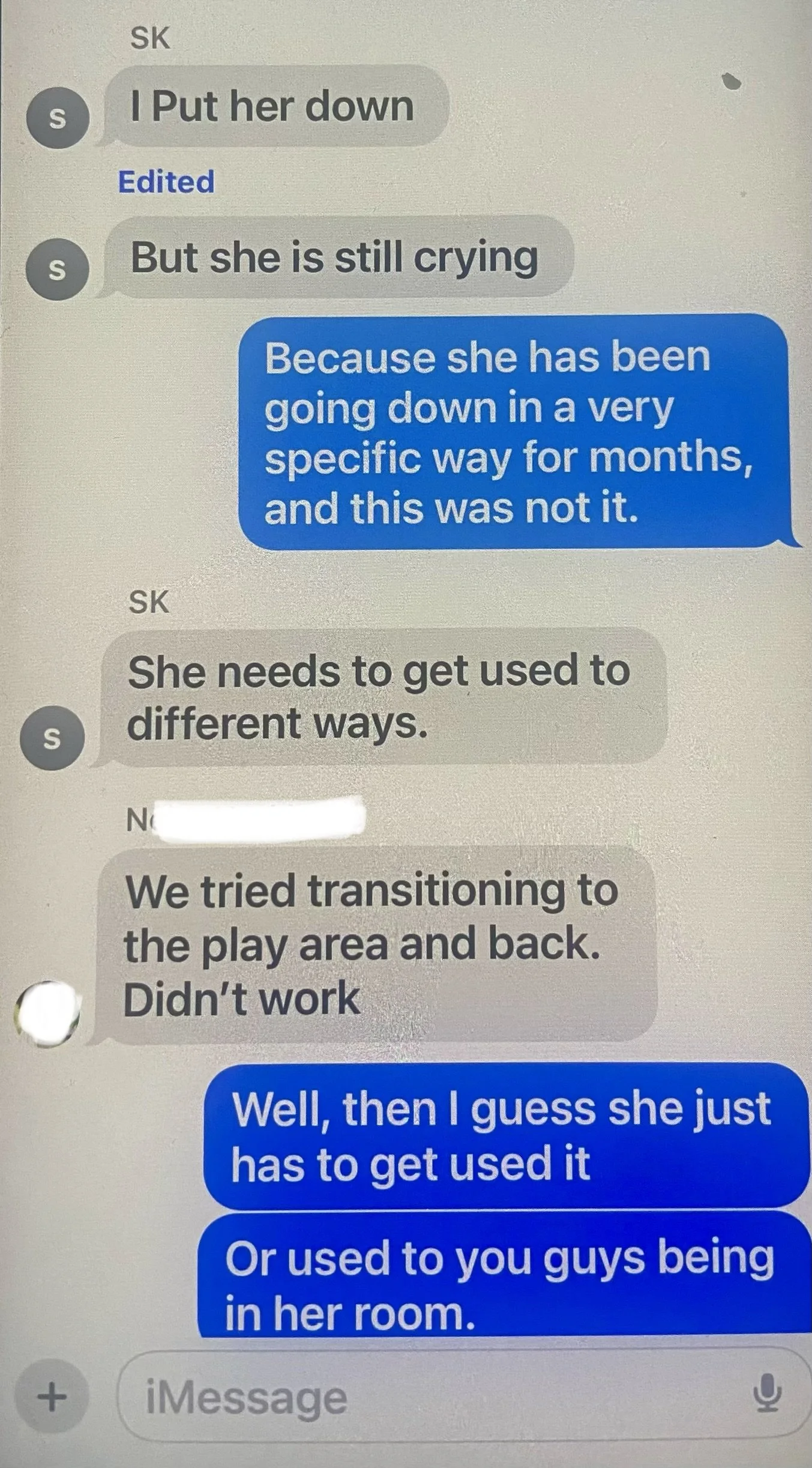
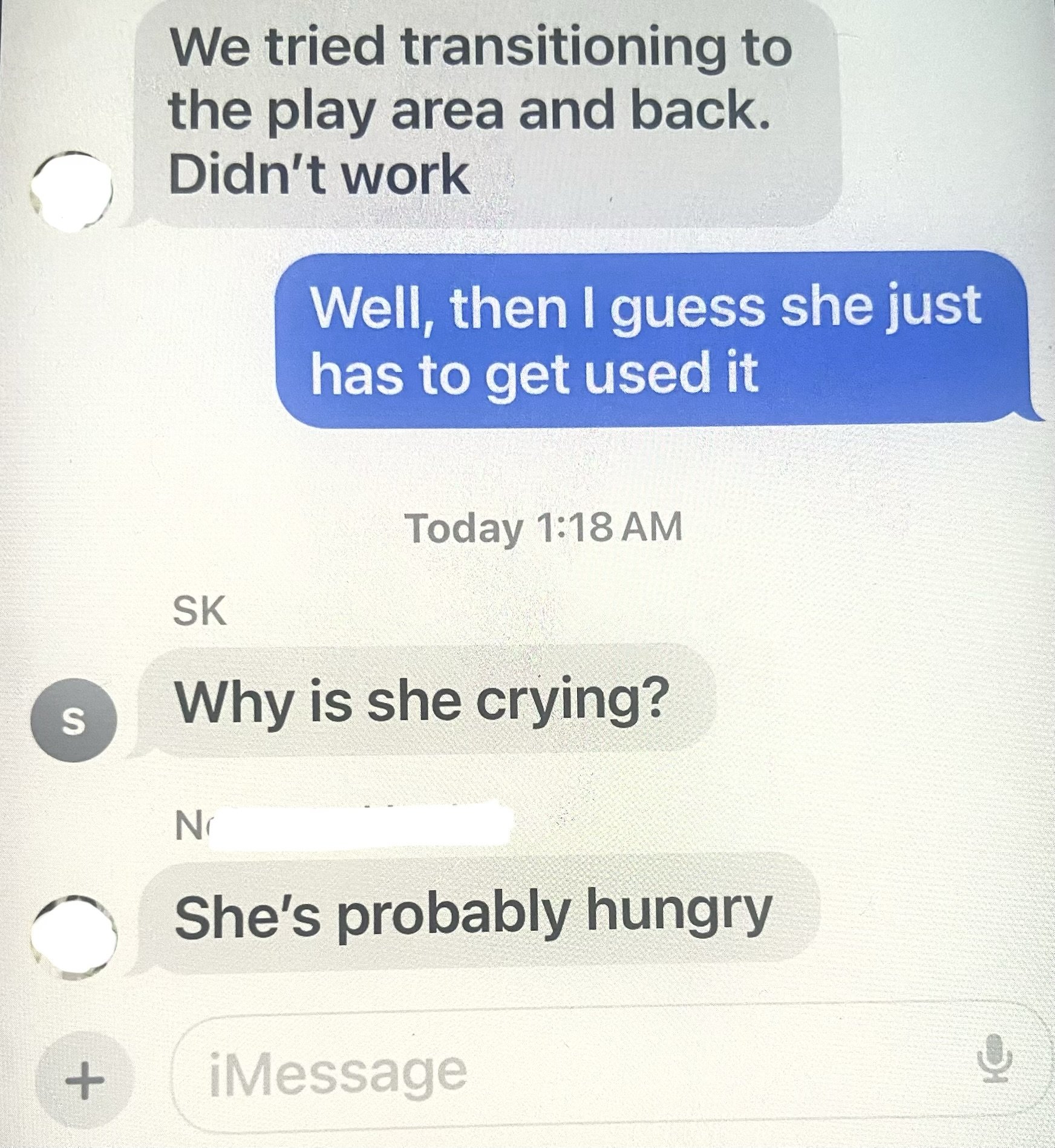
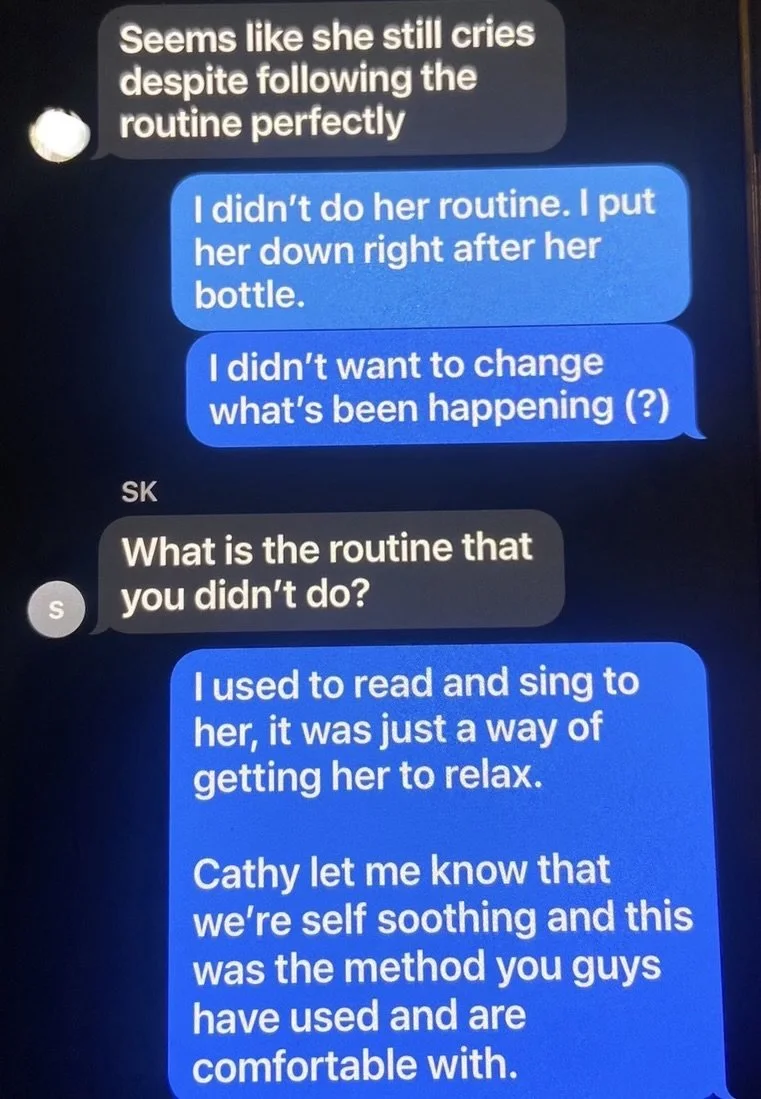
I would sometimes receive texts in the middle of the night telling me the baby was crying.
So I would check the monitor.
And because the monitor could be rolled back, I could review what had actually happened.
On multiple occasions, what I saw did not match what I had been told.
The baby appeared to have slept through the night.
And that matters because nighttime rest isn’t some abstract concept for a live-in or travel nanny.
It’s recovery.
It’s the thing that allows you to function the next day.
If you are being awakened because someone believes a child is crying, and you check the record and find that the child apparently wasn’t crying, what is happening to your nervous system?
What happens when that becomes part of a larger environment in which you already feel watched?
Again, I am not saying every nighttime text is abusive.
I’m asking a workplace question:
What systems exist to protect a domestic worker’s rest when the worker’s workplace is also someone’s home?
And then there was the cold.
The baby’s room was extremely cold.
I complained about it. My co-nanny complained about it.
The household controlled the temperature.
I raised the issue with Cathy.
Nothing changed.
So I was trying to care for a baby in a room where I believed the temperature was inappropriate while having limited control over the environment itself. I was stressed about leaving a space heater on, for any amount of time. So I'd set it on a timer, creep in around 4am to turn it on again, and physically change the thermostat at 6, when it was time for me to get up if I intended to have ANY semblance of peace or personal care for myself that day.
This is another strange feature of private domestic work.
In most workplaces, an employee can report an environmental condition to someone whose job is to address workplace conditions.
In a private home, the person responsible for fixing the environment may be the same person creating or controlling it.
There is no neutral party standing between the employer’s preference and the worker’s working conditions.
The house is their house.
But it is also your workplace.
And that distinction has to mean something.
And then came the meetings.
Meetings while I'm trying to eat for the first time since 6am, meetings when I finally get a moment to breathe because a nap finally lined up with whatever schedule they decided we were going with that day.
There were always meetings about things I was supposedly doing wrong- but never solutions or anything that would produce actual change.
I was told that the parents had seen things on the cameras.
But they weren’t regularly in the home.
So I started wondering:
Who was watching?
When?
For what purpose?
Like, don’t they have actual jobs to do? (and no, they owned a company…and ownership means they manage those who do the work, never having to be aware of what those at the very bottom of that hierarchy are dealing with- and that works well because distance sets up denial beautifully in these instances)
Were employees informed that cameras were being used for performance evaluation?
Were there written policies?
Were observations documented?
Was I given an opportunity to explain what they saw?
Or was the camera simply another way for someone with more power to decide that I was doing something wrong?
Because professional autonomy doesn’t mean a nanny gets to ignore the family’s wishes.
It means the nanny should be allowed to exercise professional judgment within clearly defined expectations.
If the employer wants a particular standard, establish it.
Train the worker.
Discuss it.
Document it.
Don’t create a workplace where the employee discovers the standard only after somebody ‘watched’ her violate it.
The thing I can’t escape is that I loved the children.
I need to say that because otherwise people will misunderstand the entire story.
I loved those babies.
I still don’t want any child involved in this story to feel unloved.
I don’t want them to feel less than.
I don’t want them to feel like they were responsible for what happened between adults.
I don’t want them to feel like they were in competition with each other, especially with me.
And I hope they remember how ‘Wildly Capable’ they are- as I would tell them often.
They didn’t ask for any of this.
And I would never punish a child because adults failed to manage their own relationships.
That’s one of the things I find so painful about this kind of work, a nanny can be deeply attached to a child while simultaneously being deeply unhappy with the conditions under which she is expected to care for that child.
Those things aren’t contradictory.
In fact, they may be the reason the worker stays too long.
Because leaving doesn’t feel like leaving a job.
It can feel like abandoning a child who may not be cared for in the ways they require to grow.
And that’s an extraordinary psychological burden to place on a worker.
I even felt sorry for the Mother, not pity, but understanding, empathy even.
After everything that happened, when I was talking with my former co-nanny about what had happened to me, I remember telling her that I was sorry for their Mom.
Not because I excused what happened.
Because I could see something beyond the behavior.
I don’t know what her childhood was like.
I don’t know what her life before coming to the states was like.
I don’t know much of what she’s experienced in life.
So obviously I can’t tell her story for her.
But I could see a woman who, from my perspective, had become extremely invested in a particular structure of family, gender, success, power, and control.
And I wondered what it had cost her to become the person she was.
I wondered whether she had ever been allowed simply to be a person.
And I wondered whether some women, after spending their lives learning how to survive within a patriarchal system, can eventually reproduce the very hierarchy that constrained them, especially when they’ve finally acquired power over someone else.
And it’s not an excuse- understanding how a system produces behavior is not the same thing as absolving the person who exercises that behavior.
I can have compassion for someone and still say: You hurt me.
Both things can be true.
But what I couldn’t understand was the lack of reciprocity.
I was expected to love their children.
To know their children.
To protect their children.
To advocate for their children.
To anticipate their children’s needs.
To notice things the parents might miss.
To regulate their children’s emotions.
To absorb the chaos around them.
To put the children first.
And I did.
But where was the reciprocal responsibility?
Who was responsible for seeing me?
Who was responsible for noticing when I was exhausted?
Who was responsible for noticing when the job had become unsustainable?
Who was responsible for protecting my rest?
Who was responsible for making sure the workplace was psychologically safe?
Who was responsible for listening when I said something wasn’t working?
Who was responsible for asking whether the person providing extraordinary care was herself being cared for?
This is the crux of domestic labor.
We expect nannies to love children as though they are family while simultaneously reminding them that they are employees.
The worker is expected to give the emotional commitment of family without receiving the protection that family supposedly provides.
And then act surprised when the worker breaks.
A nanny’s love should never require her disappearance.
I don’t regret loving those children.
I don’t regret seeing them.
I don’t regret noticing things.
I don’t regret trying to help.
I don’t regret introducing foods.
I don’t regret getting on the floor.
I don’t regret trying to help a child develop confidence in her own body.
I don’t regret refusing to treat one child as less important than another.
I don’t regret caring.
What I regret is believing that caring harder could make an inherently unequal relationship reciprocal.
It couldn’t.
Because the problem was never whether I loved the children enough.
The problem was whether the people employing me understood that I was a person too.
A nanny’s commitment to a child should never require the nanny to abandon herself.
That should not be controversial.
It should be a basic workplace standard.
So what happens when the person who sees the problem is the person with the least power?
This is the question I keep returning to.
Maybe the baby wasn’t developing exactly as I expected.
Maybe my interpretation of some things was wrong.
Maybe some of the family’s decisions had explanations I didn’t know.
Those are possibilities I am willing to acknowledge.
But there is one thing I know:
I was there.
I saw what I saw.
I documented what I was required to document.
Another nanny documented her own exhaustion, the housekeeper too.
I raised concerns.
I asked questions.
I told management when the workload was unsustainable.
I reported environmental concerns.
I experienced being monitored.
I experienced being corrected based on camera observations.
And eventually, I was terminated over the phone for a ‘safety issue’ that was never identified.
And that’s not the end of the story, it’s the beginning of the question.
Because if a highly paid private household can employ a professional caregiver, continuously observe her work, expand the scope of her responsibilities, disrupt her rest, control her working environment as well as her off-time and private living arrangements, demand extensive documentation, question her judgment, and ultimately terminate her without a clear explanation of the alleged violation, then the question cannot simply be whether that particular family was difficult.
The question has to be: What protections does the private domestic staffing industry provide for the person inside the house?
Who protects the nanny?
Who investigates?
Who determines whether a complaint is legitimate?
Who reviews the employer’s conduct?
Who decides whether surveillance has crossed a line?
Who determines whether a job has materially changed?
Who protects a worker who says, “This is not sustainable”?
And perhaps most importantly:
Who protects the person who is protecting the child?
I began documenting my experience because I was required to write down what happened to the children every day.
I didn’t know then that those records might someday help me understand what happened to me.
I didn’t know that the stories I wrote about their days would become evidence of my own.
I didn’t know that the thing I was being paid to do: pay attention, would eventually force me to pay attention to the workplace itself.
But that’s what happened.
I saw the baby.
I saw the work.
I saw the system.
And eventually, I realized that the question wasn’t whether I was willing to love somebody else’s children.
I was. I always am.
The question was whether an industry built on intimate care was willing to recognize that the person doing the caring deserves care, dignity, boundaries, rest, professional respect, and protection too.
I don’t think that’s too much to ask.
It’s literally the bare minimum.